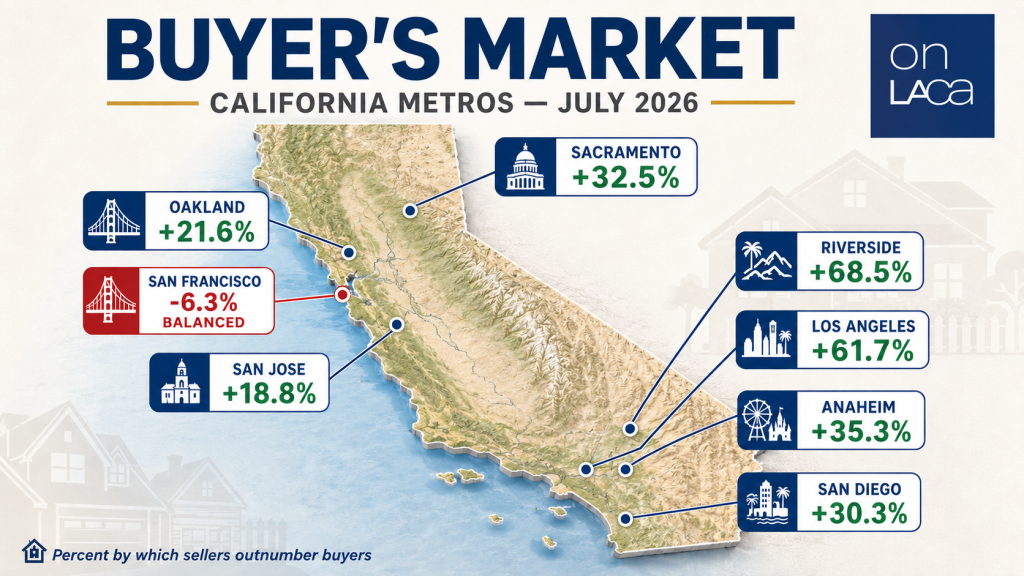
New report indicates, it’s finally a buyers market–especially in LA, Riverside. San Diego, Sacramento and Anaheim. There are a record low number of buyers–51% more sellers than buyers–creating a unique opportunity to buy. July was a historically bad month for demand according to a report from the real estate website Redfin, and with so many California cities moving into ‘buyer’s market’ territory, now may be the right time to stop being a looky-loo.
Here are the California markets from the Redfin report–most of which are buyer’s markets:|
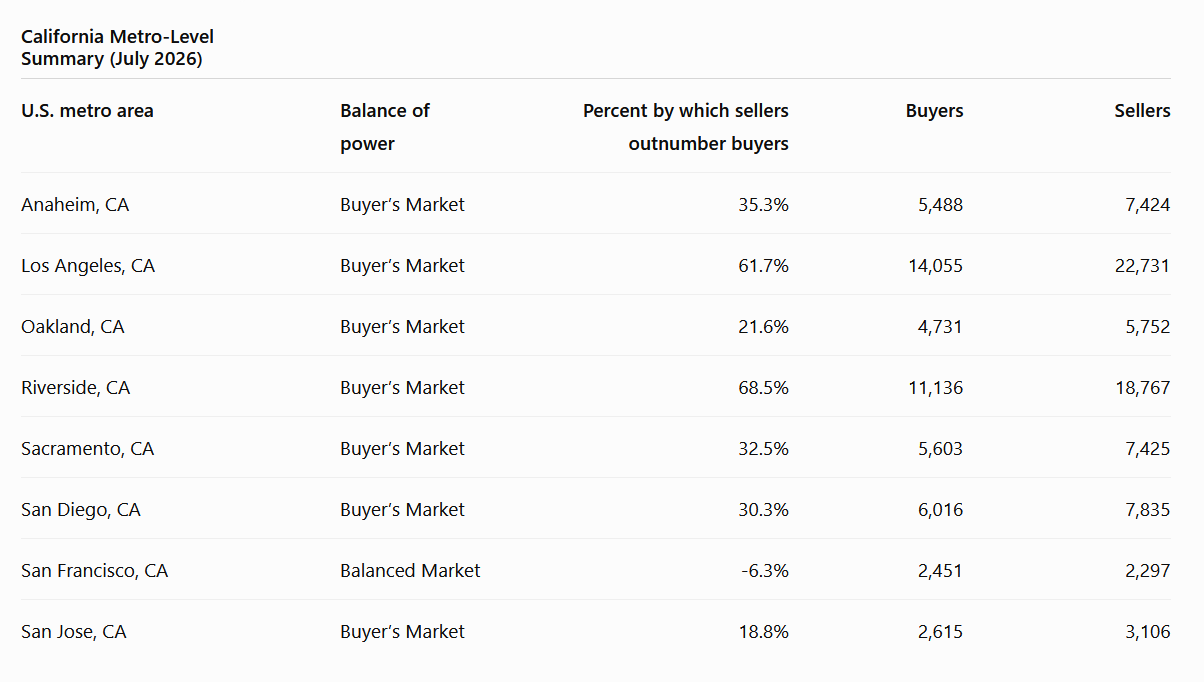

More Detail: California Metros Swing Toward Buyer’s Markets Amid Record Low Homebuying Demand
A sweeping correction is underway in the U.S. housing market as nationwide homebuying demand plummeted to an all-time record low in July 2026. Driven by surging mortgage rates, high housing costs, and persistent economic uncertainty, an estimated 966,752 buyers remained in the market compared to a staggering 1.46 million active sellers. This national inventory surplus has officially pushed nearly 80% of major U.S. metro areas into distinct “buyer’s market” territory, giving the house hunters who stay the upper hand in negotiations.
In Southern California, Los Angeles has officially crossed over into a buyer’s market due to the widening gap between supply and demand. According to Redfin’s data, sellers outnumber buyers in the Los Angeles metro area by a substantial 61.7%. The area registered 22,731 active sellers against just 14,055 active buyers through July. This inventory cushions local house hunters with an abundance of options, forcing highly motivated sellers to reconsider stiff pricing and open the door for concessions before the anticipated early-autumn market rush.
Anaheim mirrors this cooling behavior with a 35.3% seller surplus, featuring 7,424 active listings to 5,488 buyers. Meanwhile, Riverside is experiencing an even stronger shift in buyers’ favor, where sellers outnumber buyers by 68.5% with 18,767 active listings on the market. This regional trend highlights a broader transformation across Southern California, where the hyper-competitive multi-offer bidding wars of previous years have faded into a more calculated and patient environment for shoppers.
In stark contrast, parts of the San Francisco Bay Area are holding on as some of the last balanced real estate micro-climates in the country. The city of San Francisco itself is classified as a “balanced market,” where the gap between sellers and buyers sits at a tight negative 6.3%—representing 2,297 active sellers to 2,451 buyers. This tight inventory keeps the local market stable, preventing a total slide into buyer privilege. However, neighboring Bay Area metros are showing signs of the broader slowdown. Oakland has skewed into a buyer’s market with a 21.6% seller surplus (5,752 sellers to 4,731 buyers), while San Jose sits closely behind with an 18.8% surplus.
AI helped compile the data