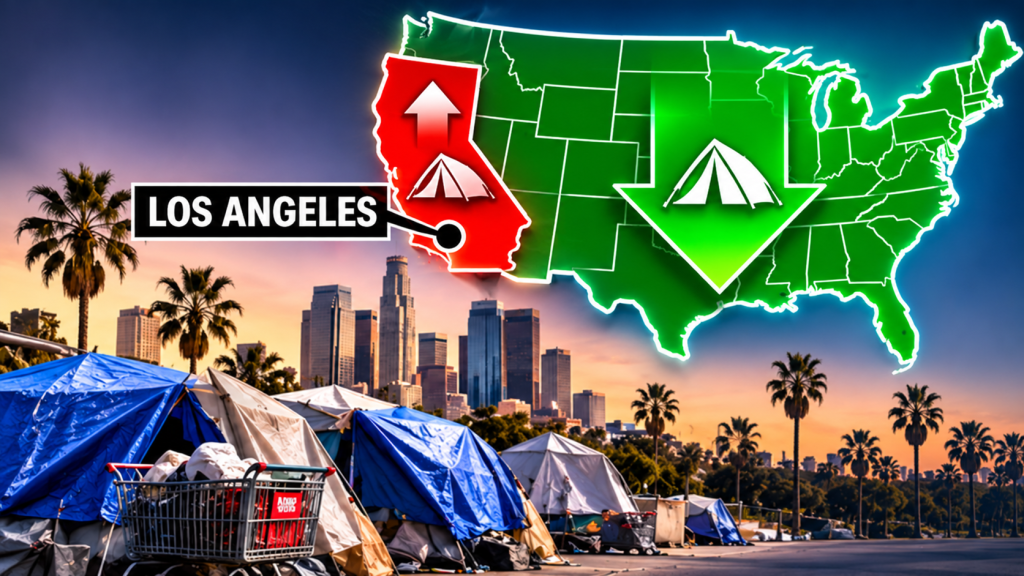
Homelessness is down 6.3% since Trump took office. Down across the USA. But not in Los Angeles.
Homelessness is declining across America. But apparently, Los Angeles didn’t get the memo. New figures from the U.S. Department of Housing and Urban Development show 698-thousand Americans were homeless in January — a 6.3 percent decline since President Trump took office.
But in Los Angeles County, homelessness increased 1.2 percent, to more than 73-thousand people. In the City of Los Angeles, the increase was 3.4 percent, to more than 45-thousand. And the number of people living on the streets in the city jumped nearly eight percent.
California is a magnet for, by many counts, 30% of the entire country’s homeless, and Los Angeles County alone accounts for more than 10% of America’s homeless population, despite having less than three percent of the nation’s population. HUD Secretary Scott Turner credits the national decline to the Trump administration’s policies and says the federal government is abandoning its Housing First approach in favor of Treatment First, emphasizing addiction treatment and recovery.
Meanwhile, Los Angeles continues spending billions addressing homelessness, with little measurable improvement–indeed a retreat– in its latest count, and just elected a DSA mayor who is on record opposing prohibiting encampments from being close to schools.
From the HUD website:
According to data from the 2026 nationwide Point-in-Time (PIT) count, 698,425 individuals were homeless on a single night in January, a 6.3% decrease since President Trump took office in 2025. This follows historic border control and a Supreme Court victory reaffirming the right of local governments to limit dangerous encampments.
Under the Biden Administration’s Housing First mandate, homelessness increased 28% from 2022 to 2025. This is why HUD is dispensing with this harmful approach and implementing Treatment First policies to help Americans tackle addiction.
“President Trump’s actions to secure the border, get criminal illegals off our streets, and restore safety to our communities drove a historic decrease in homelessness,” said Secretary Turner. “However, after a decade of failed Housing First policies, homelessness remains near a historic high. Clearly, there is more work to do. HUD is rejecting the addiction-fueled depravity seen from LA’s Skid Row to New York’s ‘Boulevard of Broken Dreams’ and moving to Treatment First to restore lives of self-sufficiency.”
Under the Biden Administration’s open border policies, illegal immigrants filled America’s homeless shelters and homelessness increased largely in states with Sanctuary City policies like New York, Illinois, California, and Massachusetts.
In July 2025, President Trump signed an Executive Order on “Ending Crime and Disorder on America’s Streets,” which empowered HUD to tackle substance abuse as part of addressing homelessness and protecting public safety, shifting from the failed Housing First policies.
In June, Secretary Scott Turner announced the most competitive homelessness assistance funding in history to invest in approaches that deliver results and received a record-setting 3,700 new applications from across the country.
In August, he rolled out the “Best Practices Toolkit: Addressing Homelessness and Addiction through Treatment First” alongside the Department of Health and Human Services (HHS) and the Office of National Drug Control Policy (ONDCP).