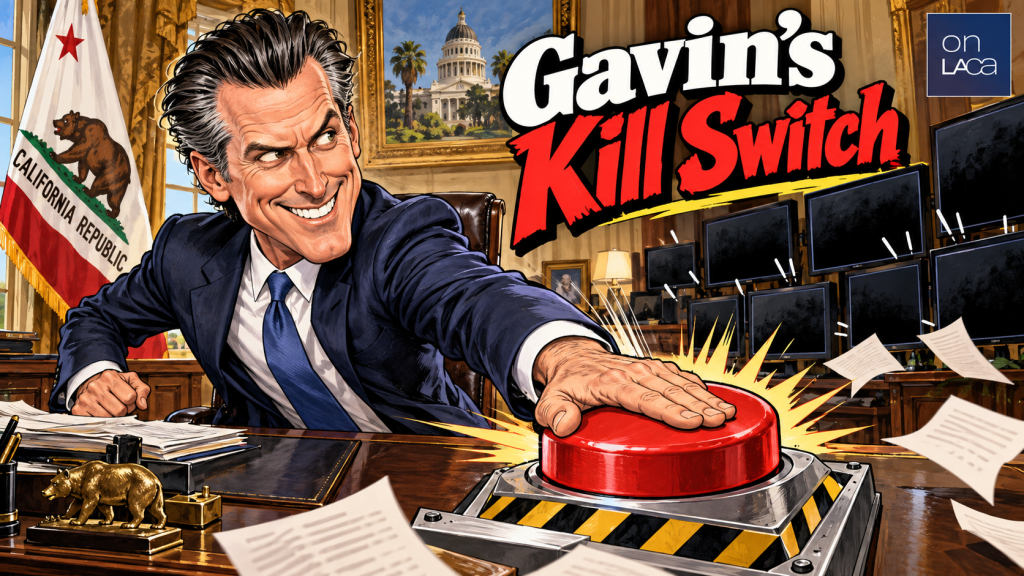
A gloomy outlook for California’s budget as Gavin leaves a $2,000,000,000 hole for Becerra (and taxpayers) for next year and an even more massive deficit for 2028. And the just-released California Legislative Analyst’s Office (LAO) report has this warning: Reserves Not Nearly Sufficient to Cover Shortfalls in the Event of a Stock Market Crash.
The deficit would have been even bigger had the tech-driven stock market boom not lifted state revenues, still the report is ominous: Existing Commitments Exceed Revenues.This is the 5th consecutive year of California deficits.
Bad news as the guy who wants to be in charge of the US leaves the governorship, as the guy who barely campaigned for the office (and who colleagues in the Biden Administration say was unprepared and ineffective) in deep debt. Newsom is like the cat who ate the canary–this was sure to happen and it is not a feather in Newsom’s cap.
Here is the bleak and scary Executive Summary from the report. Read it and judge for yourself:
Stock Market Poses a Serious Risk to Revenues. Since 2023, the state budget has been the beneficiary of an extended stock market boom. Even now this boom appears to be resulting in continued strength in income tax collections. That said, while the stock market’s recent run has been great for many investors and the state budget, it now appears to have advanced to a dangerous stage. The risk now facing state revenues is that this boom, like many in the past, will abruptly end in a bust.
This Fiscal Outlook Meaningfully Incorporates This Risk. The state must decide how much revenue it can depend on having to pay for current services to Californians who rely on them. We view building a state budget around revenues that do not incorporate the meaningful danger of a market downturn as unduly risky. As such, our Fiscal Outlook explicitly incorporates this risk in two ways. First, to offer some insurance against a stock market downturn, our revenue forecast is somewhat weaker than suggested by recent collection trends, but still well above where it would be if a market crash occurred. This is the forecast we recommend policymakers use as a starting point to reduce the likelihood the state makes commitments it will be unable to afford in the future. Second, to gauge the state’s preparedness for a stock market downturn, we present an estimate of the state’s budget condition under a scenario where the stock market peaks at the end of this year and crashes over the course of 2027.
Under Our Forecast, Existing Commitments Exceed Revenues. Under our forecast, there is a small deficit of $2 billion at the end of 2027‑28. Starting in 2028‑29, however, deficits would be considerably larger, as shown on the left side of the figure. Although these out‑year deficits have narrowed from the ones we projected a year ago—mainly due to the artificial intelligence (AI)‑driven stock market surge and ongoing reductions enacted in this year’s budget—deficits persist because the underlying imbalance has not been fully resolved.

Reserves Not Nearly Sufficient to Cover Shortfalls in the Event of a Stock Market Crash. If the current AI boom is a speculative bubble that ends in a bust, there will be severe budget shortfalls. As the right side of the figure shows, under this scenario, annual deficits would exceed $30 billion. If something like this scenario occurs, the state’s reserves and borrowing capacity will be insufficient, almost certainly necessitating sizeable ongoing cuts or revenue increases within a couple of years.